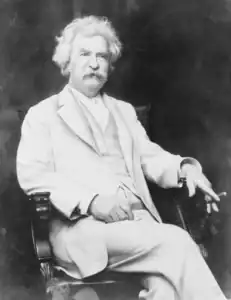
 Over the years, there have been questions as to whether or not Lew Wallace and Samuel Clemens (Mark Twain) ever crossed paths. There is anecdotal information that perhaps they did, but no clear and definitive proof. In 2002, a message was left on our museum answering machine from a fellow in Indianapolis. He had recently purchased a home that was built by Ovid Butler back in the 1840s or 1850s. According to him, a Mr. Shaw, a wealthy cattleman from Indianapolis purchased the home from the Butlers, and a brochure was done either then or when Mr. Shaw’s daughter, Mrs. Brenner, owned the house, which stated there was a room in the home where a photograph was taken of Mark Twain and Lew Wallace visiting. The Butler’s were related by marriage to Lew Wallace and Twain did visit Indianapolis on different occasions, so a meeting is possible. Both were also on national speaking circuits where their paths might have crossed somewhere beyond Indiana. Despite research, this photo and the brochure have not been found and few other references put Clemens and Wallace together anywhere.
One possible sighting of the two men together is recorded in the book Lew Wallace: Militant Romantic by Robert & Katharine Morseberger. In the fall of 1884, Ulysses Grant was dying of cancer but was feverishly working on completing his autobiography. Mark Twain had assisted Grant in making arrangements for the publication of the book and Twain supported it financially. Grant’s finances were a shambles because of bad investments and he and Twain hoped the publication of his memoirs would generate money sufficient for Mrs. Grant and the family after his death.
Twain’s support of General Grant was not only an effort to help one of America’s most beloved figures who had fallen on hard times. For Twain it was also a way to repay an old family debt. Twain was born Samuel Clemens. His parents were John Marshall Clemens and Jane Lampton Clemens. Together John and Jane had seven children; four died young while three survived into their 20s. The family left Kentucky, moving to Tennessee, then Florida, Missouri before settling in Hannibal, Missouri in 1839 when Samuel Clemens was four years old.
John Clemens was well respected but had difficulty earning enough money to adequately support his family. By 1846, the Clemens family finances were failing. A physician and apothecary, who lived across the street from the Clemens home, and his wife invited the Clemens family to move in with them so that the Clemens could rent out their small family home on Main Street. When John died in March 1847, it left Jane and her surviving children almost destitute. Thanks to the doctor and his wife, Jane and her children had a roof over their heads and the family stayed together. It also gave Sam Clemens, the future Mark Twain, ideas for his stories of life along the Mississippi. Ironically, the death of John Clemens allowed Jane to save enough money to move her children back home. The pharmacist was Dr. Orville Grant, a first cousin to General Ulysses Grant. The generous act by Dr. and Mrs. Grant allowed Jane to keep her family together and earn enough money to eventually move back into the family home. It was a kindness Samuel Clemens never forgot.
In November of 1884, Twain called on Grant to discuss the book arrangements and as recorded by Mrs. Julia Grant, he found Lew Wallace visiting at the Grant home. In a footnoted citation, the Morseberger’s relate that according to a book by Justin Kaplan titled Mr. Clemens and Mark Twain, Mrs. Grant was reported as saying to the two men: “There’s many a woman in this land that would like to be in my place and be able to tell her children that she once stood elbow to elbow between two such great authors as Mark Twain and General Wallace.” To this Twain responded, “Don’t look so cowed, General. You have written a book too, and when it is published you can hold up your head and let on to be a person of consequence yourself.”
Although Wallace was still serving as the United States Minister to the Ottoman Empire, he was stateside in the fall of 1884, so the timing of this visit with Grant is possible. If it did happen as recorded, Twain was either uninformed, unconcerned with accuracy, or just giving Wallace a hard time, as by 1884 Wallace had published both The Fair God and Ben-Hur (which Mrs. Grant was likely referring to) as well as numerous articles and essays. If Twain did address Wallace with those comments, it would not have endeared Wallace to Twain, and he probably would not have pursued any friendship.
Twain was widely known for his garrulous nature and seldom shared compliments—especially where rival authors were concerned. In a New York Times article on Samuel Clemens, they reported that Clemens had a habit of making editorial notes in the margins of books he read—much as Wallace did. While there are apparently no mentions of notes on any of Lew’s fiction, Twain scribbled in his copy of the 1906 autobiography of Lew Wallace, “The English of this book is incorrect & slovenly & its diction, as a rule, barren of distinction.”
Wallace passed away in 1905 before completing his autobiography so whether Twain is referring to Lew’s portion of the work, Susan’s writing, or even Mary Hannah Krout’s contributions can’t be known. But had he been alive, just as in 1884, Lew certainly would not have appreciated Twain’s comments—however, he might have related to them. Wallace made similar notes about other authors in the margins of books he read. One of his favorite comments when an author wrote something Lew found disagreeable was “Bosh!”
In one last Wallace-Twain tangent, in November of 1935, more than 1,000 guests celebrated the centennial of Twain’s birth at a party held in the New York City Waldorf-Astoria Hotel. Thanks to radio, additional guests joined the party from Bermuda, San Francisco, and Honolulu. The guest list was impressive as was the list of those who sent messages. Among the greetings read to guests at the party were those from Rudyard Kipling, James Barrie, Booth Tarkington, and Eugene O’Neill. Among the impressive guests in attendance was President Franklin Roosevelt.
A program was designed to recapture the spirit and era of Mark Twain. The evening featured a rare 1908 motion picture of Twain, stereopticon slides showing scenes from a 1905 birthday party for Twain, and songs of the Mississippi sung by the 40 voice Donald-Heywood Negro chorus. It closed with a tableau with “Twain” surrounded by the characters he created. As part of this tableau children of literary families were selected to portray the young people in Twain’s stories. Among the children featured were Margaret Wallace who portrayed The Pauper and William (Billy) Wallace as Tom Sawyer. Margaret and William were two of Lew Wallace’s great grandchildren. Lew Wallace Jr. and his wife Josephine (the parents of Margaret and William) were likely present in the audience. Although young Margaret and William never met their illustrious ancestor, the reflected glow of this impressive celebration must have alerted them to the important role that their great grandfather had played on the stage of American arts and culture as well as the esteem in which he was still held.

