“I resolved to give up the dream. Still it haunts me. At this day even, I cannot look at a great picture without envying its creator the delight he must have had the while it was in evolution.” This quote from Lew Wallace conveys his appreciation for the arts and the artists who created beauty. Lew and Susan Wallace knew a great many of the creative leaders of the 19th century. Included in their collection of friends and associates were a number of sculptors including Randolph Rogers, Thomas Buchanan Read, and William Wetmore Story. In their personal photo album is a picture of a woman who is identified as “sculptress.” Vinnie Ream was not just any sculptress and not just any woman—she was a remarkable lady who was a trailblazer.
Lavinia (Vinnie) Ream was born in a log cabin in Wisconsin in 1847. Sources on Vinnie state that as a child Winnebago Indians taught her to draw and paint. When she was about 7 years old her family moved to Washington, D.C. where they lived for several years before additional moves for her father’s career took them elsewhere. During this first exposure to Washington, Vinnie began modelling in clay with the sculptor Benjamin Paul Akers.
In 1861, the Ream family returned to Washington, D.C. Although she was only 14 years old, she became one of the first women hired by the U.S. Postal Department to assist with the surging growth in mail during the Civil War. Vinnie also spent time writing letters for wounded soldiers, working in the hospitals and singing in hospital concerts and for churches.
A girl of boundless energy and enthusiasm, Ream visited the sculptor Clark Mills with Missouri Congressman James Rollins. While watching Mills work, she suddenly said, “I can do that.” Surprised at her comment, Mills gave her some clay which she fastened into a medallion of an Indian chief’s head. Impressed by her talent, Mills asked her to serve as his apprentice. She kept her job with the postal service and worked part-time in Mills’ studio.
Ream was a beautiful, talented and vivacious girl and she was soon making relief medallions and portrait busts of congressmen and other important leaders in Washington. She also began selling pictures of herself and mounted an intense self-marketing campaign to raise her visibility. She allowed her long wavy hair to flow loose in a day when m
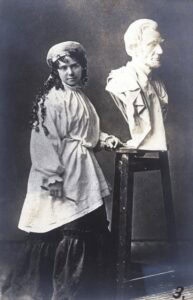
ost women wore their hair carefully secured and she wore dramatic Bohemian costumes and large, colorful jewelry. Her notoriety spread and even her father was to comment after a trip to Louisiana: “What have you ever done to cause your name to be hawked about and mixed up in such a manner? You are made notorious against your will, your name and fame are bound to outlive you. Just think, when we are all dead and gone, someone will write a novel about you and another will write a play. Your studio in the Capitol will be a grand tableau…. [Congressmen]Bingham and Butler will be in the play and there will be broken statues…and Thaddeus Stevens will be one of the heroes.”
In 1864, several of her congressmen admirers asked President Lincoln to sit for Vinnie for a bust. Lincoln at first declined but when he heard of her humble origins, he accepted the invitation and sat for Vinnie for half an hour each morning for five months. The completed bust was wonderfully executed and well received. In late April of 1865, Congress voted to give the 18-year-old sculptress a commission to create a life-size statue of the recently assassinated Lincoln. Thanks to this commission, Vinnie became the first woman and the youngest person to receive a congressional commission as an artist. According to reports, to get the proper measurements for the statue, she was given the clothing Lincoln was wearing the night he was shot.
Her commission was not without controversy. She was deemed too young and inexperienced by some, while others whispered accusations that she was a “lobbyist” and a public woman of questionable reputation. Additional controversy arose when Senator Edmund Ross* of Kansas boarded with the Ream family during the impeachment trial of President Andrew Johnson. Ross cast the deciding vote against impeaching Johnson, and many accused Vinnie of influencing his vote. The controversy was serious enough that she and her unfinished sculpture of Lincoln were almost forcibly evicted from the room in the Capitol where she was working. Only the intervention of several influential New York sculptors defused the situation.
However, with the commission secured and her finished model of Lincoln approved, Ream and her parents moved to Italy where she selected special white Carrara marble. They lived in Rome for two years while Ream turned her plaster model into the finished marble figure. During her time in Rome, Vinnie continued to promote herself by arranging introductions with Gustave Dore, Franz Liszt, and Cardinal Antonelli. She studied with a number of famous sculptors in Italy, but rumors continued to follow Vinnie. Some commented that her Italian workmen were responsible for the Lincoln sculpture she was working on—a practice that was actually not uncommon at the time.
The finished statue of Lincoln was unveiled in the Capitol Rotunda in 1871, when Vinnie was just 23 years old. She was clearly a talented sculptor and rumors of her artistic ability were soon laid to rest. Other rumors, however, continued to swirl as she was a strikingly attractive woman who was not shy about self-promotion and was adept at securing favors from Senators, Civil War Generals and at least two Presidents. As a result or the rumors, commissions did not always come her way.
She went on to open a studio in New York before returning to open a studio in Washington. In addition to artistic statues of anonymous goddesses, children and women she created busts and full statues of people like George Armstrong Custer, Robert E. Lee, and Admiral Farragut. She exhibited at the American Institution Fair in 1871, Centennial Exposition in 1876, and the Columbian Exposition in 1893. She also produced the first free-standing statue of a Native American for Statuary Hall when she carved a likeness of Sequoyah for the State of Oklahoma. This was her final commission and was not placed in Statuary Hall until 1917, three years after her death.
Vinnie married Richard Hoxie of the U.S. Army Corps of Engineers in 1878 and they had one son. They moved following her husband’s career to different assignments but ultimately settled in Washington, D.C. and both are buried in Arlington National Cemetery. After her marriage to Hoxie her career as a sculptress proved less central to her life and she accepted only a very few commissions. She did continue to be a feature on the social circuit as she entertained guests at parties with her singing and with playing the harp.
Her statue of Lincoln still stands in the Rotunda. Whether she was “. . . an untutored genius, a self-taught sculptor and daughter of the West who proved that privilege and social refinement were not requirements for success in the United States . . .” or an “. . . upstart opportunist who used her strikingly good looks to manipulate powerful middle-aged men. . . in order to secure government patronage for her art” she left a lasting legacy.
Vinnie Ream was an original and a Google search proves many are still fascinated by her. The Wallace’s knew Vinnie and Susan Wallace was given a bas-relief portrait of Abraham Lincoln created by the talented sculptress, likely in 1864. At some point Susan gave this portrait of Lincoln to her good friend and Crawfordsville native Caroline Krout. A bronze plaque has been found in the Montgomery County Historical Collection at Lane Place and researchers feel it is likely the Ream gift to Susan. It was donated to the Historical Society in 1939 by Isaac Elston III shortly after the death of Caroline Krout’s brother, Robert. Researchers have also found Lew’s name in a guest register Vinnie kept. In addition, she clearly must have been important to them, as Susan and Lew Wallace included Vinnie’s photograph in their album that was filled with family and very close friends.
Thanks/Sources: Thanks to Gail Stephens for recognizing the name in significance of the photo of Vinnie Ream in the Wallace photo album and to Jill Matthews and Owen Bennett with the Montgomery County Historical Society..
- European Journal of American Studies. Vol 6, No 2 | 2011 : Special Issue: Oslo Conference Lincoln’s “Unfathomable Sorrow”: Vinnie Ream, Sculptural Realism, and the Cultural Work of Sympathy in Nineteenth-Century America
- http://www.vinnieream.com/ Vinnie Ream (Hoxie) Sculptor of the Abraham Lincoln statue in the U. S. Capitol Building
- Arlington National Cemetery Website
- Julia LeClerc Knox, “Some Interesting Crawfordsville People and their Homes,” Indiana Magazine of History 22 (September 1926): 294.
- Katherine E. Manthorne, Researcher, Author: Art & Culture of the Americas
*Edmund Ross served as Governor of the New Mexico Territory from 1885-1889, a few years after Lew Wallace served as Territorial Governor from 1878-1881.
Museum’s Vision
The General Lew Wallace Study and Museum celebrates and renews belief in the power of the individual spirit to affect American history and culture.
Museum’s Mission
The General Lew Wallace Study & Museum is deeply committed to the protection and preservation of Lew Wallace’s legacy now and for generations to come.

