In the spring of 1872, Lew Wallace travelled about 100 miles north to the Allegheny House on Lake Maxinkuckee to fish and to put the finishing touches on his first major novel, The Fair God. Wallace had been working on the book intermittently for almost 30 years. He had the time to devote to the novel because his other efforts to secure income outside of his law practice had not been successful. Despite his significant work on behalf of the Republican Party, President Grant had not rewarded him with a political appointment. Wallace had requested a consulship in Brazil, which was not offered, followed some months later by a request to be Minister to Bolivia. Although this request came with letters of support from Senators Morton and Pratt of Indiana and from Congressman John Coburn, a general, schoolmate, and cousin by marriage to Wallace, it too went nowhere.
Although his political connections did not support a change in his career path, his personal connections were significant and proved to be very helpful. Wallace was an unusual man and had the good fortune to know many of the most important men of the 19th century. One of these was Whitelaw Reid. Born in Ohio, Reid had risen to prominence in the Republican Party, but more importantly for Wallace, he was the editor of the New York Tribune, a powerful Republican newspaper. Coincidently, Reid purchased the paper in 1872 after the death of Horace Greeley. As Wallace began to consider publishing his new novel, Whitelaw gave him a letter of introduction to James R. Osgood of Boston, the owner of one of the most important publishing houses in America.
James R. Osgood was a child prodigy who knew Latin by the age of three and entered Bowdoin College in Maine at the age of 12, graduating Phi Beta Kappa. He moved to Boston and entered the firm of Ticknor and Fields as a clerk but soon became a partner. Ticknor and Fields gained a reputation for their publication of The Atlantic Monthly among other prominent works. Among the authors published by either Ticknor and Fields or J.R. Osgood & Company were Bret Harte, Henry Wilson (who wrote a popular three volume history of the Civil War), James Russell Lowell, Walt Whitman, William Dean Howells, and Mark Twain.
Wallace submitted his novel and a few weeks later it was recommended for publication by one of Osgood’s readers. “Dear Sir,—It is safe to pronounce this book (I haven’t its title) remarkable in theme and treatment. It is a romance founded on incidents in the invasion of Mexico by Cortés, and seems to be a translation from some old Spanish author, who personally knew some of the actors in that drama, and who has impressed his narrative with a realism truly astonishing. The book is specially fascinating; and, indeed, valuable, by reason of its minute and vivid pictures of Aztec civilization, whose characteristics it brings out in impressive and beautiful relief. The chronicles of fighting, or rather of massacre, are somewhat tedious, abstractly considered; but in their connection the reader can hardly grow weary of them. … “
Wallace immediately travelled to Boston where he began working on the proof sheets. Reading the proofs took about four hours each day and Wallace made so many changes that the printer ultimately complained to Osgood, but the publisher ruled in favor of Wallace’s revisions. During the balance of each day, Wallace was a tourist of the sites of Boston. He wrote home to his friend, Maurice Thompson: “I go and come as I please—am master of that without which one cannot be free, my time.”
Wallace also was able to renew his acquaintance with Osgood’s junior partner, Captain Benjamin H. Ticknor and together the men visited with all the “literary stars” of Boston. Ticknor and Wallace would remain friends and correspondents for the rest of their lives. Miss Caroline Ticknor, a daughter, remembered Wallace as kind and gentle, but noted he discussed Shiloh with “terrible earnestness.” With all of the celebrated authors they met, Wallace was, perhaps, most taken with William Dean Howells. Nicknamed “The Dean of American Letters” for his prolific and erudite works, Howells is best remembered as the editor of The Atlantic Monthly.
In August of 1873, Wallace’s book was presented to the public. It was generally well received, although it did have critics. An early critic was Dr. Charles White, President of Wabash College who had read rough drafts and encouraged Wallace to drop the enterprise. As Susan Wallace wrote in her portion of her husband’s Autobiography. “From the date of its publication, in the fall of 1873, to April 1905, there were sold one hundred and forty-five thousand seven hundred and fifty copies of The Fair God. With this success the verdict of the first critic to whom th
e author, then a very young man, submitted the introductory chapters of his story is strangely at variance. This was no less a person than Dr. Charles White, the second president of Wabash College, a lineal descendant of Peregrine White of the Mayflower, and a man of eminent scholarship.
The young author, unabashed by the somewhat austere dignity of the old president, asked permission to read to him what he had finished. Dr. White listened politely, took off his spectacles, and then gravely advised Mr. Wallace to abandon the field of authorship. He had been long in his grave when The Fair God appeared, or he might have had an opportunity to learn how little the wisest of men can foresee the fate of any book.” It sounds like Susan relished the success of The Fair God after the early assessment by Dr. White.
It was perhaps better received in England than in America, which gave Wallace his first taste of international fame. Susan Wallace wrote: London Athenæum, then as now difficult to please, said:
“We do not hesitate to say that The Fair God is one of the most powerful historical novels that we have ever read. . . . The opening, like that of most archæological novels, is dull, but the scene where in the sunrise Montezuma reads his fate, the dance scene, and the entrance of the Spaniards to the capital, are drawn in a style of which we think few living writers capable, and the battles are Homeric in their grandeur.”
Whitelaw Reid compared Wallace and his novel favorably to Sir Walter Scott’s Ivanhoe, and to Carlyle, while others compared his work to Ossian, the Arabian Nights, Lord Byron, Clement Moore, Charles Kingsley, and Edward Bulwer-Lytton. The man who had recommended the publication of the novel to James Osgood was Samuel R. Crocker. Coincidently, Crocker had founded the prestigious Literary World and, as it was his first literary discovery, Crocker promoted Wallace’s book with a tremendous write up.
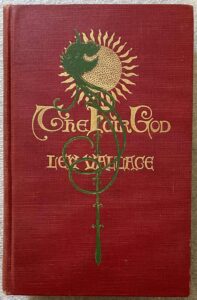
Within the first year it sold 7,000 copies and went through 16 printings before the impact of Ben-Hur boosted sales throughout the 19th century. Gene Stratton-Porter, famed Hoosier author, commented this was Lew’s best book and John Hay, Lincoln’s close associate and a prominent 19th century politician called The Fair God and Ben-Hur the two finest historical novels of the age. By World War II it had sold over 216,000 copies, making it Wallace’s second best-selling novel.

